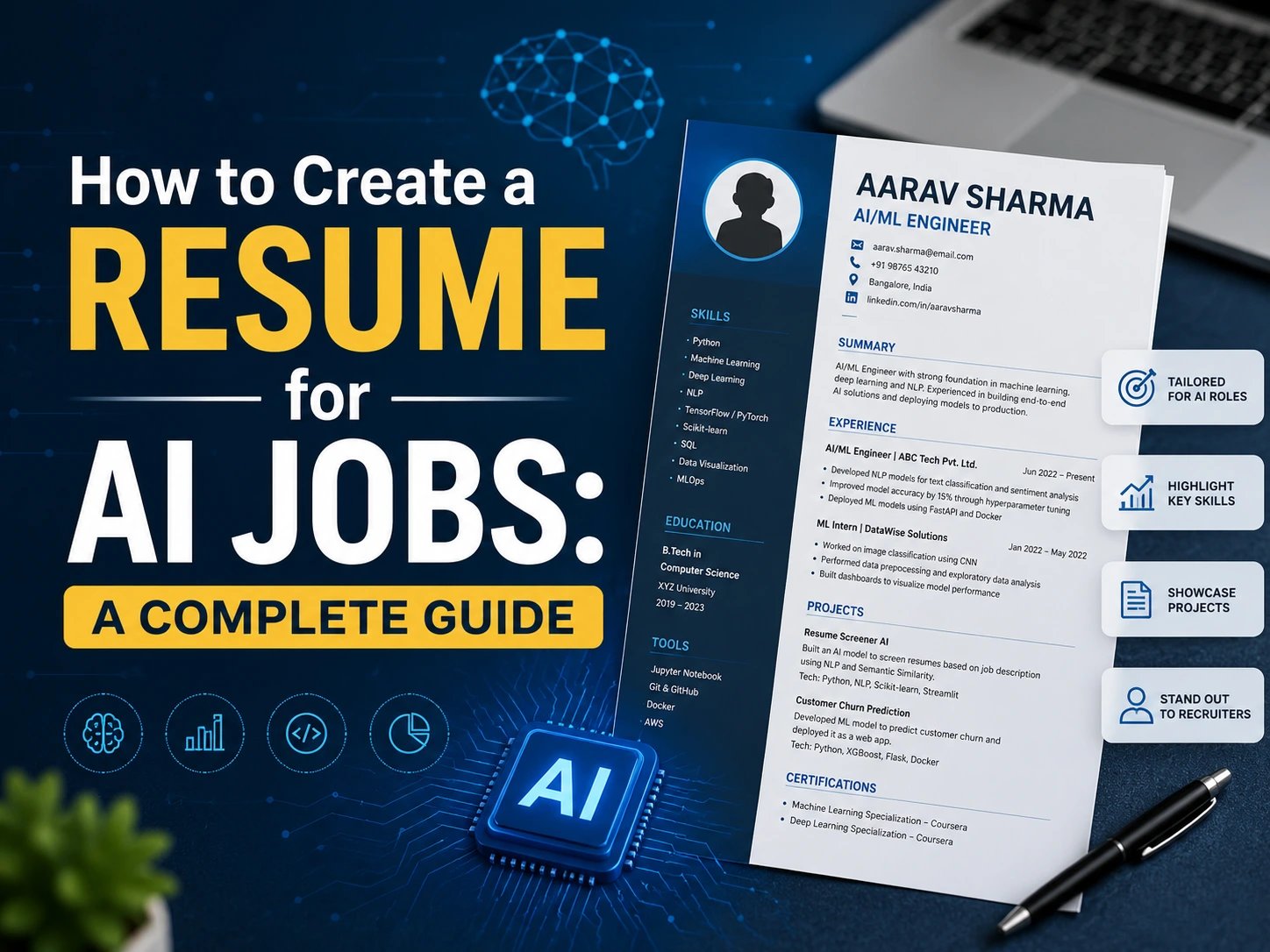
How to Create a Resume for AI Jobs: A Complete Guide
Artificial intelligence is changing the job market faster than many other areas of technology. Companies across healthcare, banking, finance, manufacturing, retail, cybersecurity and software are hiring professionals with AI and machine learning skills.
That has also changed what employers look for in a resume.
If you're applying for an AI Engineer, Machine Learning Engineer, Data Scientist, Generative AI Engineer, AI Product Manager or another artificial intelligence role, simply listing "AI" or "ChatGPT" on your resume isn't enough. Your resume needs to demonstrate what you know, what you have built and how you have used AI to solve real-world problems.
So, how do you create a strong resume for AI jobs?
Let's look at the key elements that can make your AI resume more relevant, professional and ATS-friendly.
1. Start With the AI Job Description
Before writing or editing your resume, read the job description carefully.
AI jobs can have very different requirements. An AI Engineer may need Python, machine learning and deep learning, while a Generative AI Engineer may need experience with LLMs, RAG, embeddings and vector databases. An AI Product Manager may need a combination of AI knowledge, product management and business skills.
Look for the technologies, qualifications and responsibilities that appear in the job description.
For example, if the employer is looking for:
Python | Machine Learning | TensorFlow | PyTorch | NLP | AWS
and you have experience with these technologies, make sure they are clearly visible in your resume.
This also helps your resume perform better in an Applicant Tracking System (ATS), which many companies use to screen applications.
The key is to use relevant keywords naturally. Don't add technologies simply because they appear in the job description if you don't actually have experience with them.
2. Write a Strong AI Resume Summary
The professional summary is one of the first sections a recruiter will read.
Avoid generic statements such as:
"Hardworking professional seeking a challenging position in a reputed organization."
Instead, use the summary to quickly communicate your experience, AI specialization and key technologies.
For example:
AI/ML Engineer with 5+ years of experience developing machine learning and Generative AI solutions using Python, PyTorch, TensorFlow and NLP. Experienced in building predictive models, RAG applications and AI-powered automation solutions for enterprise use cases.
If you're transitioning into AI from another technology field, make that part of your story.
For example, a software engineer could highlight their software development background while demonstrating recent experience with Python, machine learning, LLMs and AI projects.
3. Highlight the Right AI Skills
Your technical skills section should make it easy for recruiters to understand your capabilities.
Instead of creating one long list, organize your skills into categories.
Programming: Python, SQL, Java, R
Machine Learning: Regression, Classification, Clustering, Feature Engineering
Deep Learning: TensorFlow, PyTorch, Keras
Generative AI: LLMs, RAG, Prompt Engineering, Embeddings, Fine-Tuning
NLP: Transformers, BERT, Text Classification, Sentiment Analysis
Cloud: AWS, Microsoft Azure, Google Cloud
AI Frameworks & Tools: LangChain, Hugging Face, OpenAI APIs
Only include technologies you genuinely know. AI recruiters and technical interviewers can quickly identify candidates who have simply copied a list of keywords.
4. Include AI and Machine Learning Projects
Projects are especially valuable if you are a fresher, student or professional transitioning into artificial intelligence.
For example:
AI Resume Screening System
Developed an NLP-based application to compare resumes with job descriptions using semantic similarity and embeddings. The system identifies relevant candidates and helps reduce the amount of manual screening required.
This is much stronger than simply writing:
"Created an AI resume screening project."
Explain the problem, your contribution and the technology used.
Other AI project ideas include:
- AI chatbot
- RAG-based question-answering system
- Customer churn prediction
- Fraud detection model
- Sentiment analysis application
- AI recommendation engine
- Document summarization tool
- AI interview assistant
- Image classification system
For each project, try to explain what you built, how you built it and what result it produced.
5. Show Measurable Results
One of the easiest ways to make an AI job resume stronger is to focus on results rather than responsibilities.
Compare these two examples.
Weak:
Responsible for developing machine learning models.
Better:
Developed a machine learning model that improved customer churn prediction accuracy by 18%, helping the business identify high-risk customers.
The second version gives the recruiter much more information.
Whenever possible, include numbers related to:
- Model accuracy
- Cost reduction
- Time saved
- Revenue generated
- Productivity improvements
- Automation percentage
- Number of users
- Processing volume
A useful approach is:
Action + Technology + Problem + Result
You don't need a number in every bullet point, but your most important achievements should be measurable whenever possible.
6. Highlight Generative AI Experience
Generative AI has created many new job opportunities and new skills employers are looking for.
If you have practical experience, consider highlighting skills such as:
- Large Language Models (LLMs)
- Prompt Engineering
- Retrieval-Augmented Generation (RAG)
- Embeddings
- Vector Databases
- AI Agents
- Fine-Tuning
- Natural Language Processing
- Document Intelligence
- LangChain
- Hugging Face
- AI APIs
However, don't simply write "ChatGPT" in your skills section.
Instead, explain how you used Generative AI.
For example:
Developed an LLM-powered document analysis application using prompt engineering, embeddings and RAG to retrieve information from enterprise documents.
This provides much stronger evidence of practical AI knowledge.
7. Make Your AI Resume ATS-Friendly
Many organizations use Applicant Tracking Systems to filter resumes before a recruiter reviews them.
An ATS-friendly AI resume should have a clean structure and readable formatting.
Use standard headings such as:
- Professional Summary
- Technical Skills
- Professional Experience
- Projects
- Education
- Certifications
Avoid putting important information inside images, graphics or complicated design elements.
Use relevant keywords from the job description, but don't stuff your resume with keywords.
For example, if a job requires Python, TensorFlow, NLP and AWS, those terms should appear naturally in your skills, projects or professional experience where appropriate.
A simple and well-structured resume is generally a safer choice than an overly designed resume for technology positions.
8. Freshers: Use Projects to Demonstrate Your Skills
If you are a fresher applying for AI jobs, you may not have professional experience—and that's okay.
Your projects, internships, academic work, certifications and technical skills can demonstrate your potential.
For example:
AI Interview Assistant
- Built a Python-based application that generates interview questions based on a candidate's job profile.
- Integrated an LLM API to generate role-specific questions.
- Created prompt templates to improve the consistency of generated responses.
Projects like this give recruiters something concrete to evaluate.
If possible, include your GitHub repository or portfolio so recruiters can explore your work.
9. Add GitHub, LinkedIn and Your Portfolio
An online presence can strengthen an AI job application, particularly for technical positions.
Include:
- GitHub
- Personal portfolio
- Kaggle, if relevant
- Publications or research profiles, where applicable
Your GitHub doesn't need dozens of projects. A few well-documented projects are often more valuable.
For each project, include a short explanation of:
- The problem
- The solution
- Technologies used
- Your contribution
- How to run the project
- Results or screenshots
This gives employers evidence beyond what is written on your resume.
10. Customize Your Resume for Each AI Job
Avoid sending exactly the same resume for every AI position.
An AI/ML Engineer resume may emphasize:
Python | Machine Learning | Deep Learning | PyTorch | TensorFlow | Cloud
A Generative AI resume may emphasize:
LLMs | RAG | Prompt Engineering | Embeddings | Vector Databases | AI Agents
An AI Product Manager resume may emphasize:
AI Strategy | Product Management | Analytics | Business Transformation | Stakeholder Management
Your basic resume can remain the same, but your summary, skills, projects and experience should reflect the requirements of each position.
11. Include Relevant AI Certifications
Certifications can be useful, particularly if you're moving into AI or building expertise in a new area.
Depending on your career path, relevant certifications may cover:
- Machine Learning
- Artificial Intelligence
- Generative AI
- Cloud AI
- Data Science
- Deep Learning
- AI Product Management
Don't add every certificate you've completed. Choose certifications that are relevant to the AI job you're targeting.
12. Keep Your AI Resume Simple and Focused
An effective AI resume doesn't need to contain every technology you've ever worked with.
For most candidates:
Freshers: 1 page
Professionals: 1–2 pages
Senior professionals: 2–3 pages, when necessary
Remove outdated technologies, unrelated responsibilities and information that doesn't support your application.
The recruiter should be able to understand your professional background quickly.
Common AI Resume Mistakes to Avoid
Several mistakes can weaken an otherwise good AI resume.
Adding too many keywords
Don't list every AI technology you have heard of. Only include skills you can confidently explain.
Using a generic resume
A generic resume may not clearly demonstrate why you're suitable for a particular AI position.
Listing responsibilities instead of achievements
Show what you accomplished rather than simply describing your job duties.
Claiming skills you don't have
AI interviews can be highly technical. If you list Python, PyTorch, RAG or LLMs, be prepared to answer questions about them.
Over-designing your resume
Complex graphics, excessive icons and unusual layouts may make your resume harder for an ATS to read.
Not including projects
Projects provide valuable evidence of practical AI skills, especially for freshers and career changers.
AI Resume Checklist
Before submitting your resume for an AI job, check the following:
- Does my resume match the job description?
- Have I included relevant AI keywords?
- Are my technical skills easy to find?
- Have I included practical AI projects?
- Have I demonstrated measurable achievements?
- Is my resume ATS-friendly?
- Are all the technologies listed genuinely familiar to me?
- Have I included LinkedIn or GitHub?
- Is the formatting clean and professional?
- Have I removed irrelevant information?
Final Thoughts
Creating a resume for AI jobs is not about filling the document with artificial intelligence keywords. It is about demonstrating that you can apply AI knowledge to solve real problems.
Whether you're an experienced AI professional, a software engineer moving into Generative AI, a data professional or a fresher working on your first AI projects, your resume should clearly communicate four things:
What you know. What you have built. What problems you have solved. And what value you can bring to an employer.
AI is evolving quickly, and employers are increasingly looking for professionals who combine technical knowledge with practical problem-solving skills.
A focused, honest and ATS-friendly AI resume can help you get noticed by recruiters and improve your chances of reaching the interview stage.
The goal isn't to create the resume with the most keywords. The goal is to create a resume that makes the recruiter think:
"This candidate has the skills and experience we're looking for. Let's schedule an interview."
Here are concise, SEO-friendly answers you can add directly to the end of the article:
Frequently Asked Questions About AI Resumes
1. What skills should I include on an AI resume?
The skills you include should depend on the AI job you are applying for. Common AI resume skills include Python, SQL, machine learning, deep learning, TensorFlow, PyTorch, NLP, Generative AI, Large Language Models (LLMs), RAG, prompt engineering, embeddings, vector databases and cloud platforms such as AWS, Azure and Google Cloud.
Don't list every AI technology you know. Focus on the skills mentioned in the job description and include only technologies you can confidently explain and demonstrate.
2. How do I write a resume for an AI job with no experience?
If you don't have professional AI experience, focus on your projects, education, internships, certifications and technical skills.
Build a few practical AI projects and describe what you created, the problem you solved, the technologies you used and the results. For example, you could build an AI chatbot, resume screening tool, RAG application, recommendation system or machine learning prediction model.
A strong project section can demonstrate practical skills even when you don't have previous AI employment experience.
3. What is the best resume format for AI jobs?
A clean, simple and ATS-friendly resume format is generally the best choice for AI jobs.
A recommended structure is:
Contact Information → Professional Summary → Technical Skills → Work Experience → AI/ML Projects → Education → Certifications
Use standard headings, readable fonts and consistent formatting. Avoid excessive graphics, tables, icons or important information embedded inside images, as these can sometimes create problems for Applicant Tracking Systems.
4. Should I include Generative AI skills on my resume?
Yes, if you have genuine experience with Generative AI.
Depending on the position, relevant skills may include LLMs, prompt engineering, RAG, embeddings, vector databases, AI agents, fine-tuning, LangChain, Hugging Face and AI APIs.
However, don't simply list "ChatGPT" as an AI skill. Explain how you used Generative AI in a project or professional environment. For example, you could describe how you built an LLM-powered application, implemented RAG or used prompt engineering to improve an AI workflow.
5. How can I make my AI resume ATS-friendly?
To make an AI resume ATS-friendly, use keywords that are relevant to the job description and place them naturally throughout your resume.
Use standard sections such as Professional Summary, Skills, Experience, Projects, Education and Certifications. Keep the layout simple, use readable fonts and avoid excessive graphics or complicated formatting.
Most importantly, don't stuff your resume with keywords. An ATS-friendly resume should also be easy for a human recruiter to read and understand.
6. What AI projects should I include on my resume?
Choose projects that demonstrate skills relevant to the AI job you're targeting.
Examples include:
- AI chatbot or virtual assistant
- RAG-based document question-answering system
- Resume screening or job-matching application
- Customer churn prediction model
- Fraud detection system
- Sentiment analysis application
- AI recommendation engine
- Document summarization tool
- Image classification model
- AI interview preparation assistant
For every project, explain the problem, your solution, technologies used and the outcome. Whenever possible, include a GitHub repository, demo or portfolio link so employers can see your work.
ALL THE BEST…….